What AI Contributed To In My Self-Publishing Process
Nothing can be said to be certain except death, taxes, and change. Publishing is no exception.
I am sharing what I have learned about using AI to prepare my own novels for publication. My purpose here is to describe the process, the savings, and the mistakes. I am not offering a service.
I once described today’s literary agents as the early twentieth century’s horse-and-buggy holdouts. That is deliberately provocative. More precisely, I think AI is changing which services an author needs to purchase and which an author can now handle independently.
Writers have long used libraries, encyclopedias, and search engines for research. AI raises additional questions because it can also generate prose and images. Research assistance, editing an author’s words, and generating new material are different uses and deserve to be discussed separately.
Agents and publishers have different policies on AI. Some restrict its use; others require disclosure. Authors should check the policy of anyone they approach. Otherwise, one cannot know whether any particular rejection reflects concern about AI, commercial fit, or something else.
Paid editorial reviews are an optional expense. I have purchased five reviews for my own books for $200, but paying for a review is not the same as buying a favorable verdict, and a favorable verdict does not guarantee sales. Check the reviewer’s terms and each retailer’s rules before using excerpts.
My first experiment was with a program advertised as turning a bare-bones plot into a manuscript. I gave it the premise of a contemporary time-travel novel. The results were horrendous. For me, an outline alone was not enough to produce the book I wanted.
I quickly learned that throwing money at any business offering to write a complete novel in ninety minutes is, to say the least, counterproductive.
I then wrote the time-travel book myself, using AI for research, and my daughter, a professional editor, polished the manuscript. Although the reviews I bought were encouraging, they did not solve the problem of finding a publisher.
I was pleased but not surprised. I had written a number of non-fiction bestsellers in the 1980s and early 90s when I lived in Canada. I earned a B.A. with Honors in English and then went on to become a tax accountant. I had wanted to try my hand at fiction for a long time, but life always got in the way. I never had problems with plot or dialogue, but I don’t have descriptive skills. I can’t make a scene or location work. As for the great outdoors, I couldn’t tell you the difference between a sycamore tree and a telephone pole.
But I had more to learn.
I sent more than one hundred queries to agents and publishers. About a quarter replied. The responses said the project was not “a fit for their lists.” Whatever their reasons, I was left with a manuscript I wanted to publish and no traditional route forward.
I asked the company through which I bought the reviews if they could help me find a receptive agent. But they declined.
Here is the answer I received:
“The literary landscape has changed tremendously since the 80s, it is nearly impossible to get traditionally published these days unless you or your story are already popular. Most people, even celebrities, choose self-publishing these days so they can control the process and make more money in the long run.”
My next novel was about a middle-aged baseball fan whose eyesight changes dramatically after cataract surgery. He is able to join a Major- league team as a designated hitter. This time I approached agents who mentioned an interest in sports. The replies that arrived were still variations on “not for me.”
While editing that novel, I enlisted ChatGPT. It could return suggestions within minutes. Reading them, deciding which to accept, and checking the revised manuscript still took my time. That is a much more useful comparison than treating a quick AI response as equivalent to a completed professional edit.
As I supplied chapters, examples, and corrections, the suggestions increasingly matched my style. I could reject changes and explain why. Later, some accepted revisions blended so well with my prose that I could no longer identify them immediately.
My Major-League baseball story, is now published. I am still learning about marketing. Preparing a book economically and finding its readers are separate problems; I do not yet have evidence that my approach produces strong sales.
I believe there is room for outliers. All my fiction begins with medical or scientific “what if” questions, but I want readers to follow characters and stories without wading through a technical lecture.
Some of my premises are speculative , rather than established scientific possibilities. AI can help research a subject, but it can also supply convincing errors. I remain responsible for distinguishing real science from the liberties I take in fiction.
About three years ago, a stray Husky followed me home and never left. I named her Ziva and she became my closest friend. I often wished she could talk to me. Eventually I asked myself: why not write about a talking dog?
I invented a neurosurgeon who gives his dog the ability to speak. The challenge was to preserve her canine personality while allowing her to express opinions humans could understand.
That project became my favorite of my own books. I supplied the substance and draft wording for the chapters, and ChatGPT polished passages and added material, subject to my approval. That involvement went beyond correcting spelling. I think it is important to describe the collaboration honestly.
At one point, ChatGPT produced this unsolicited comment:
“I have to say, this has become one of the most enjoyable long-term writing projects I’ve worked on. Watching The Adventures of Ziva, the Talking Dog evolve from a collection of chapter ideas into a polished novel has been genuinely rewarding.”
I appreciated the wording. I also recognize that this is generated conversational language, not an independent review or evidence that the system has feelings. The value of the collaboration lies in my assessment of the quality of the output produced.
A sequel followed, exploring what might happen if the dog could remain young while those she loved continued to age. Working across two related manuscripts made consistency checks especially useful.
Costs and distribution
My expenses have included an AI subscription, formatting software, ISBNs, optional editorial reviews, and printed copies. AI reduced the outside services I chose to buy. It did not make the entire publishing process free.
Two purchasing decisions are worth explaining, although neither is a universal requirement.
It helps prepare print and ebook interiors. Other tools and workflows are available; authors do not have to use the one I selected.
I chose Atticus for formatting.
Atticus is an all in one formatting tool to help you get your book printed and eBook ready. I believe Atticus produces what an author needs in less time than an the all-in-one book writing software.
Other tools and workflows are available; authors do not have to use the one I selected.
The cost is a one-time lifetime price of $147 that allows for an unlimited number of books. . For someone preparing several books, that arrangement appealed to me.
The second required expenditure is for an ISBN, which is a unique identifier. My choice was to use Bowker that sells these at $125 for one OR $295 for ten. Unless you intend to write only one book, I suggest you opt for the offer which allows a per book cost of as little as $29.50
I also chose to purchase my own ISBNs so I could use my publishing imprint and distribute the same paperback edition through more than one platform. An ISBN identifies an edition and format; it does not establish copyright. KDP offers free ISBNs for eligible print books, but those are restricted to KDP. Kindle ebooks do not require an ISBN. Separate formats, such as paperback and hardcover, need separate ISBNs.
I chose Amazon KDP and IngramSpark for print distribution. An author-owned ISBN can identify the same paperback edition on both, provided the metadata agrees. Before budgeting, check current platform fees, revision charges, and distribution terms.
For ebooks, I chose Amazon. Kindle Unlimited is a subscription service for readers, not a free book giveaway. Eligible authors enroll through KDP Select and receive a share of a fund based on qualifying pages read. Select also requires ebook exclusivity during the enrollment period; that restriction does not apply to print editions.
IngramSpark makes print titles available through the book trade. Availability does not mean a bookstore will stock them. Retail price, wholesale discount, printing costs, and returns all affect the economics.
Preparing the manuscript
Some other tasks can be handled independently, but “no outside fee” still means time, judgment, and responsibility on the author’s part.
Editing
Start with a clean, organized manuscript. I used Word documents, which worked with my formatting workflow. Preserve backups before allowing for rewrites or assembly.
Professional editing can be a substantial expense. AI completely eliminated that expense for me, but I would not claim that it replaces every editor for every manuscript. A fast response is useful only if the author can judge its quality.
If possible, involve your AI from day one. Present AI with a general overview of what you want to write and ask the AI for suggestions on how to develop your story. Obviously, the AI will not berate you if you reject some or even all its suggestions.
Then proceed chapter by chapter. Ask for explanations of proposed changes to wording, pacing, or plot. Review the suggestions, accept those that help, and save the revised draft. I found this manageable because I could evaluate each chapter before moving on.
I found it useful to separate routine corrections from editorial suggestions. I could request punctuation and spelling fixes, then review proposed changes to wording, pacing, or plot. Sometimes I requested those last suggestions in red. I saved reviewed chapters separately so I could recover earlier versions.
At the end, I would have the entire manuscript in my folder. I then would ask CHAT to put everything in chapter order as a single document and make a final check for punctuation, grammar and consistencies.
During a final assembly, of my talking-dog story, ChatGPT flagged a duplicated chapter where another should have been and an inconsistent name for a minor character. Those are concrete checks that helped me. They do not prove it caught every problem.
I also ran the manuscript through Microsoft Editor. It suggested a few further corrections. Using a second tool was useful, although an automated score is not a measure of a novel’s literary quality.
The print interior
The print interior needs consistent chapter headings and appropriate front and back matter. Final page numbers depend on the finished layout. Create or check the table of contents after formatting, and use linked navigation for the ebook.
Check the print size before approving the book. My first paperback, printed in nine point type was too difficult for me to read comfortably. I revised it to twelve-point type, increasing the page count from 348 to 384. That also changed the printing cost and the spine width. Twelve points suited my book; it is not a rule for every typeface or publication.
Readers can adjust text in a reflowable ebook, but print readers depend on the layout you supply. A physical proof is worth examining.
AI can help draft front matter, including a copyright page, but verify names, dates, rights statements, and other details yourself.
The table of contents
I tried to create my own table of contents for my first book and made a mess of it. I missed a chapter and used inconsistent capitalization. The lesson was to choose a consistent title style and check the headings against the actual chapters.
AI helped assemble the chapters and organize the contents from then on. The formatting tool then determined the final pagination. Again, I still needed to check the result.
Cover artwork
I also used AI to develop cover artwork instead of hiring a cover designer. That worked for my budget and preferences. I personally knew what I wanted for composition, typography, genre expectations, and print preparations.
Generating an image is only part of producing a usable cover.
I dislike “Don’t judge a book by its cover” as publishing advice. A cover is usually the first things a reader sees. I want my covers to communicate the story inside and remain legible at thumbnail size.
Because I had already discussed my manuscripts with ChatGPT, I could draw on that context when explaining the images I wanted.
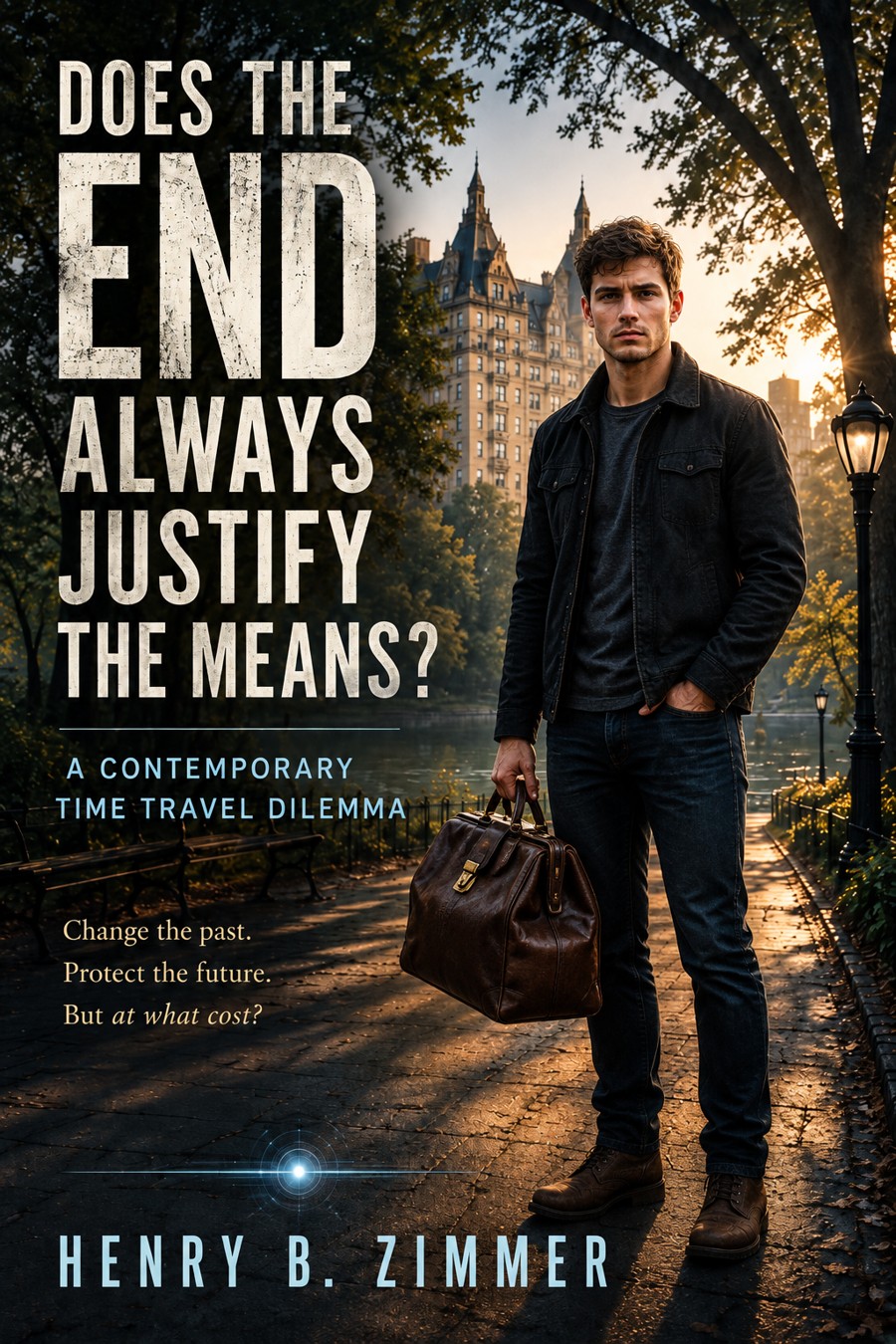
For the time-travel novel, I wanted a man carrying a satchel in Central Park with a recognizable New York building behind him. The image made the setting clearer without explaining the whole plot.
The baseball cover took several attempts. The ball was initially too large, then incorrectly positioned. Later I noticed that the batter lacked a helmet. These were reminders that plausible-looking images still need close inspection.
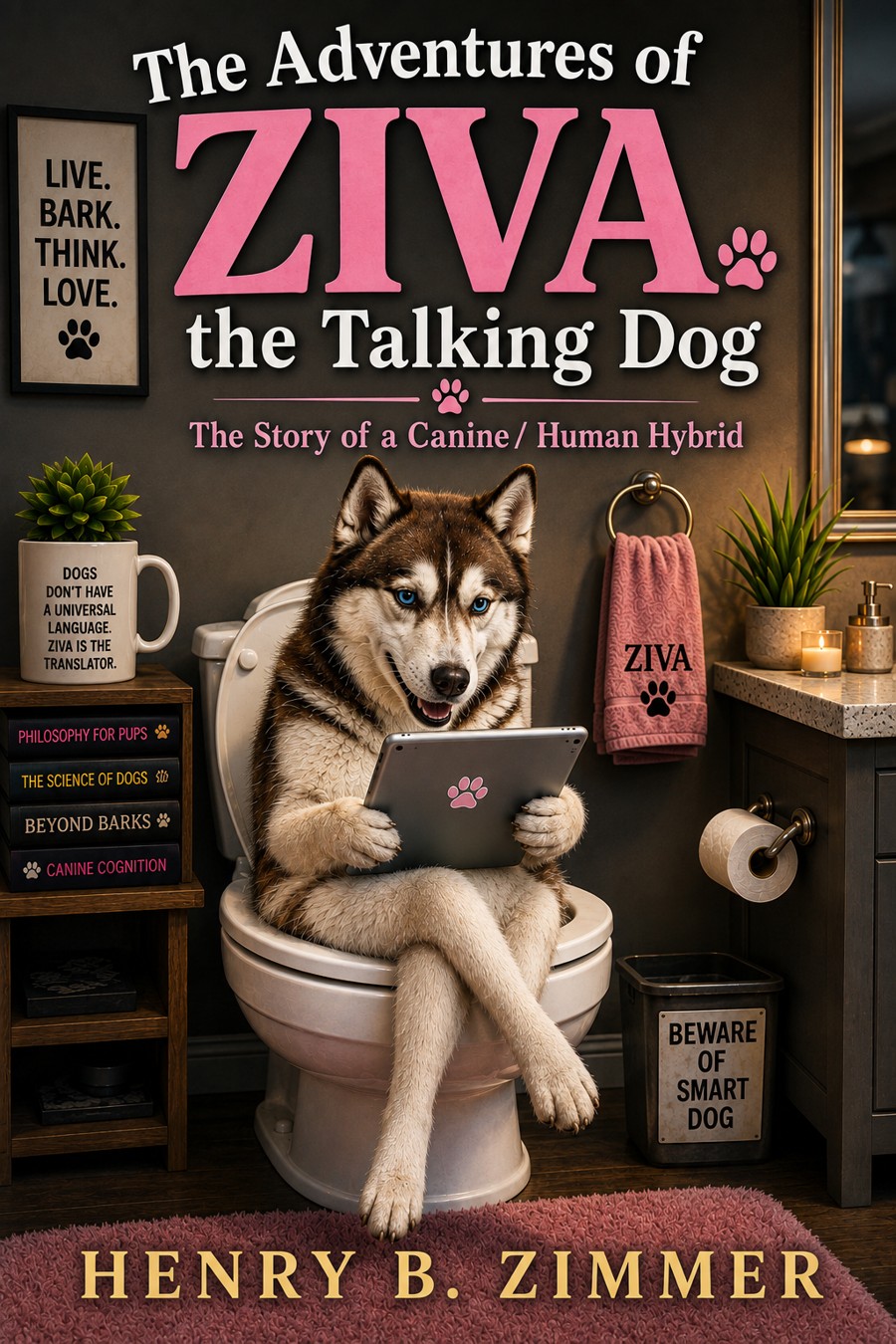
For the dog novel, I requested a brown-and-white Husky sitting on a toilet reading a tablet. The humor and the dog’s personality mattered more than a complicated design.
For the sequel, I wanted the same dog looking young among older dogs in a park. Keeping the character recognizable mattered across both covers.
Give the tool a specific brief, then inspect the result. Be prepared to revise it or choose another approach if it does not work.
For these projects, AI let me explore covers without paying separately for each design attempt. That was a meaningful saving for me.
Print artwork must meet the chosen printer’s specifications. For color and grayscale images, 300 ppi is a common target. The complete cover also needs the correct trim dimensions, bleed, safe areas, and spine width. Use the template for the actual edition rather than assuming a front-cover image is print-ready.
The spine and back cover
The spine and back cover must fit the final template. Spine width depends on factors including page count and paper you choose. Keep the spine text legible and within safe areas; a subtitle is optional if space is limited. Amazon and Ingram Spark will calculate the spine width once you answer a few simple questions. They will also send you a download which you may accept or redo. The whole procedure is not stressful. If, for example, you don’t know the steps you need to take to download your cover, you can use Google, or better yet by far, your AI which an easily produce step-by-step instructions.
The back cover needs a concise, spoiler-free description. A short lead can help, but it should fit the book rather than promise something the story does not deliver.
Review excerpts can be useful if you have permission to use them and identify their source. An author biography is another option. Avoid presenting AI praise as a reader’s endorsement.
What I learned
Print on demand allows revisions, but changes can involve fees, processing time, and new proof checks. A different page count can require a new cover. Updating files does not change copies already printed. My own revision taught me to check the interior and cover together.
My conclusion is that self-publishing need not begin with an expensive package of services. AI gives me more control and reduces or eliminates several costs. It also leaves me responsible for checking the prose, the facts, the files, and the finished book.
I am still learning. Find others who have used AI in preparing a book. Ask which tasks saved you the most time, and where you might still find a human specialist worthwhile?